Bromo Fluorobenzene: Modern Uses, Risks, and Technical Insights
Historical Development
Chemistry has always thrived on building blocks as simple as benzene rings. People tinkered with halogenated aromatics generations ago, charting out entire families of products by swapping atoms on that six-carbon core. Researchers in the early 20th century mapped out how typical halogenations—bromination and fluorination—change behavior in aromatic molecules. Experimenters discovered that adding both a bromine and a fluorine atom to benzene added layers of chemical interest, with tricky regioselectivity and reactivity. By the 1970s, chemists understood that making bromo fluorobenzenes needed tight control over temperature, reagents, and purification. Over time, new processes like directed ortho-metalation and transition-metal catalysis made it less of an ordeal to select where on the ring each atom lands, letting labs and industry produce specific isomers at scale.
Product Overview
People in labs usually pick up bromo fluorobenzene strings—like 2-bromo-1-fluorobenzene or 4-bromo-1-fluorobenzene—in small bottles labeled “for synthesis.” Specialty chemical suppliers, and not household retailers, fill the orders. These molecules crop up most in specialty applications: tools for medicinal chemistry, building blocks for more intricate aromatics, and reference materials for analytical methods. Compared to common compounds, demand is modest, but a core network of suppliers keeps it available. Every order leans on purity checks since most customers need tightly defined isomer ratios, proven with NMR and GC-MS data. In practice, cost rises quickly as purity, isomeric control, or scale increases.
Physical and Chemical Properties
Despite being a halogenated benzene, bromo fluorobenzene stands out because combining the larger, less electronegative bromine atom with the small, strongly electron-withdrawing fluorine has quirky effects on the ring. These liquids have boiling points between 150–190 °C, and generally pour out clear and colorless. Odor can be sharp but not overly persistent, a reminder that some halogenated organics evaporate easily and reach the nose quickly. These molecules resist oxidation under normal storage but may degrade if left open to strong heat or corrosive chemicals. Solubility follows the usual pattern—mixes well with organic solvents like ether or dichloromethane but avoids water.
Technical Specifications & Labeling
Bottles of bromo fluorobenzene arrive with lot numbers, CAS numbers, and chemical structure diagrams, allowing anyone in the lab to trace purity and synthesis route. Most suppliers offer purity levels at 97–99%. Some catalogues offer all three main positional isomers, making it essential for chemists to double-check what they order. Each bottle’s safety data sheet details hazards, reactivity, and recommended PPE, usually mirroring broader industry guidance for halogenated aromatics. Packaging sizes range from milliliter vials to drums for those rare big industrial runs.
Preparation Method
Crafting bromo fluorobenzene involves precise handling from the start. Syntheses typically begin with a fluorobenzene isomer, like para-fluorobenzene, then use Br2 with an iron or aluminum halide catalyst. Careful temperature control favors mono-bromination, producing a product mix that usually demands distillation or column chromatography for cleanup. Some researchers have pushed toward greener methods, swapping out solvent-heavy steps for solid-supported catalysts or phase-transfer techniques, but mainstream supply still skews toward traditional halogenation. For more control, some labs begin with benzonitrile, introduce halogens stepwise, and convert intermediates—ensuring substitution at just the right spot on the ring.
Chemical Reactions & Modifications
Pop a bromo or fluoro group onto a benzene, and suddenly you’ve unlocked a world of cross-coupling chemistry. Bromo fluorobenzene rings serve as key starting points for reactions like Suzuki, Buchwald-Hartwig, or Ullmann couplings. Chemists use these reactions to swap in bigger, biologically relevant groups, tailor reactivity for new drug candidates, or anchor aromatic motifs in advanced materials research. Having both bromine and fluorine on the ring influences electronic properties in ways that push the boundaries of classic synthetic tricks. The electron-withdrawing effect of fluorine makes some positions more reactive than others, giving researchers a handle for selectivity. The bromo group opens up oodles of possibilities for further substitution, all in one molecule.
Synonyms & Product Names
Over the years, the habit of giving each isomer a distinct name has saved chemists big headaches. You’ll find names like 1-bromo-2-fluorobenzene (also written as o-bromofluorobenzene), 1-bromo-4-fluorobenzene (para), and 1-bromo-3-fluorobenzene (meta). Some suppliers call the compounds by their CAS numbers—such as 446-38-4 for the ortho isomer or 460-00-4 for the para. Old-school literature might even call these “bromofluoro derivatives of benzene,” though this phrasing has gone out of style for clarity’s sake in digital catalogs.
Safety & Operational Standards
It pays to treat all halogenated aromatics with respect, and this rule applies to bromo fluorobenzenes each time a bottle goes onto the bench. Inhalation can irritate the airways, while skin and eye contact risks mild burns or allergic responses. The solvent-like fumes mean good ventilation or a certified fume hood keeps the workspace safe. Spills clean up best with absorbent pads, followed by licensed disposal since halogenated residues bring their own environmental baggage. Waste streams funnel through incineration or chemical treatment. Anyone handling these chemicals needs goggles, nitrile gloves, and lab coats. Storage in cool, dry cabinets, away from acids or bases, prevents container breakdown and cross-reactions.
Application Area
People working in pharmaceutical research see bromo fluorobenzene show up as a versatile tool for medicinal chemistry. Its use speeds up lead optimization by plugging into aryl coupling strategies on short notice. Research teams inject these structures into larger molecules to adjust metabolic stability, target selectivity, and pharmacokinetics in preclinical assays. Outside pharma, these building blocks filter into specialty polymers for electronics and coatings, where the halogen mix tweaks dielectric properties. Environmental analysts also spike samples with labeled versions to test for method recovery and performance during routine water quality screening.
Research & Development
As organic synthesis gets more refined, so does the drive to make building blocks like bromo fluorobenzene cleaner, safer, and cheaper. Green chemistry has made inroads, pressing for less waste and lower environmental load by cutting out toxic solvents and minimizing byproducts. In university labs, grants propel teams to design new catalysts that can thread bromine and fluorine onto aromatic rings without using harsh conditions. On the analytical side, better detection by mass spectrometry and NMR tightens up quality checks, helping research chemists snag high purity material without time loss. Pharmaceutical pipeline projects examine how swapping halogens in candidate molecules can tune biological activity against targets like kinase enzymes or protein–protein interactions.
Toxicity Research
People rely on published toxicity data to set safe exposure limits, though gaps still exist for some isomers. Studies in rodents and cell lines pin down moderate acute toxicity, mostly from irritation to mucous membranes and the liver under high doses. Chronic exposure brings up questions of organ accumulation and long-term risk—issues still under investigation. Environmental researchers worry that improper disposal adds to persistent organic pollutants, with fluorinated aromatics known for high stability and bioaccumulation in aquatic organisms. Regulatory agencies work slowly to update guidelines, so labs must keep on top of evolving best practices and emerging research.
Future Prospects
New applications for bromo fluorobenzene leaning on modern synthetic methods look promising. Demand slowly picks up in pharmaceutical circles as newer drugs require more elaborate aromatic frameworks. Manufacturers invest in continuous flow processes and automated reaction setups, lowering per-batch waste while cranking out tailored isomers on demand. Environmental research will push further into green chemistry, challenging everyone to limit emissions and eliminate hazardous byproducts. Analytical chemists explore advanced sensors using modified benzene rings with both bromine and fluorine, aiming to improve trace detection of pollutants or new drugs. The smart money backs innovations that join safety, high selectivity, and minimal environmental impact in every new bottle shipped from the factory floor.
The Building Block Few Notice
Walk into any modern chemistry lab and you’ll spot a shelf with small, tightly sealed bottles labeled with names most folks would struggle to pronounce. Bromo fluorobenzene hides among them. You won’t find it mentioned during dinner or splashed on billboards, but behind the scenes in pharmaceutical research and electronics, it plays a bigger role than most realize.
Lab Workhorses: Chasing Better Medicine
Bromo fluorobenzene steps in as a starting point for making complex molecules. Drug discovery never stops, and the search for new treatments has become a lot like solving a jigsaw with moving pieces. Chemists need compounds that make it easy to tack on new groups, build rings, or swap out atoms. Bromo fluorobenzene lets scientists do that; the bromine atom and the fluorine atom give two unique spots to start new chemical tricks.
From my experience with chemists working on cancer therapies, they like bromo fluorobenzene because it reacts cleanly in cross-coupling reactions. These are the bread-and-butter reactions in drug design that stitch together big molecular fragments. A small change in a drug molecule—say, swapping a hydrogen for a fluorine—can mean the difference between a dud and a blockbuster. Fluorine punches above its weight by changing how drugs interact in the body. Adding a bromine lets researchers attach whole new chunks, speeding up the search for better treatments.
Electronics: The Unseen Ingredient
Organic electronic materials sound futuristic, but the pieces start in glass beakers. Bromo fluorobenzene plays a role here too. Think of the thin, flexible screens we see in phones and watches. Their performance depends on how electrons move through layers built from organic molecules. Chemists need fine-tuned starting pieces to design those layers. Swapping around atoms like fluorine or bromine changes how easily the end material handles electric charge.
Television screens and even new types of solar cells benefit from these small chemical tweaks. I spoke with a research group designing organic semiconductors last year, and bromo fluorobenzene stood out because it offers a reliable handle for joining new pieces. It keeps impurities low, which matters when building electronic devices that need to last years.
Environmental and Safety Concerns
No conversation about chemicals skirts around safety. Bromo fluorobenzene isn’t something to splash around. It brings risks of inhalation, skin irritation, and potential long-term effects that toxicologists still have under review. In labs, proper ventilation and gloves stay standard. Industry relies on strict tracking, disposal routines, and limits on how much gets made or used at any one site.
The chemical industry faces real scrutiny from regulators and the public, and for good reason. Studies found that some aromatic compounds related to bromo fluorobenzene stick around in the environment. Researchers keep looking at new ways to recover solvents, cut down waste, and recycle more of what’s used in a lab. Best practices mean strong oversight, good training, and plenty of real-time monitoring.
Smart Choices For The Future
For all its value, the future of bromo fluorobenzene depends on safer, greener chemistry. The American Chemical Society and similar groups encourage alternatives and tighter controls. Some universities have adopted solvent recovery systems that cut emissions in half. Others look for less hazardous swaps—though nothing quite matches the flexibility bromo fluorobenzene brings to a synthesis.
Chemists keep weighing cost, safety, and usefulness every time they reach for that bottle on the lab shelf. In small doses, with careful hands and a sharp eye on regulations, bromo fluorobenzene helps drive big steps in medicine and tech—whether or not most of us notice.
Understanding Bromo Fluorobenzene
Bromo fluorobenzene doesn’t pop up in daily conversation, but its molecular formula, C6H4BrF, holds a lot of weight in chemistry. Picture a benzene ring, that classic hexagon found in so many molecules that connect biology, medicine, and industry. Swap in a bromine atom for a hydrogen and a fluorine for another, and you’ve built bromo fluorobenzene. This small tweak gives chemists a new set of tools. Unlike benzene, bromo fluorobenzene carries both the reactivity of its halogens and the strength of its aromatic base.
Why the Molecular Formula Matters
Chemical formulas aren’t just for textbooks or lab bench notes. The formula C6H4BrF tells chemists right away how this molecule behaves. Six carbons in a ring, four hydrogens, then a bromine and a fluorine. Change just one element and you get a new compound with a different set of risks, reactivities, and applications.
A lived example—working in research, specificity always saves time. Compounds with similar names can trip someone up if the formula isn’t clear. Understanding that “bromo fluorobenzene” points to only one bromine and one fluorine gives solid footing, especially when tracking impurities or designing a reaction path.
Impact in Real-World Chemistry
Synthetic chemists rely on halogenated benzenes for making new medicines and materials. Swapping groups on the benzene ring changes how the molecule interacts with other chemicals. Bromo fluorobenzene, with just two halogen swaps, behaves differently from pure benzene or even dichlorobenzene. Its formula dictates boiling point, solubility, and even how toxic it can become.
Fluorine’s addition boosts stability and alters metabolism. Drug designers use molecules like this to slow breakdown in the body, making treatments more effective. The bromine gives another handle for building larger molecules. The pharmaceutical industry wouldn’t have the range of modern drugs it has today without easy access to specialized benzene rings like this one.
The Importance of Clear Chemical Identification
Misidentifying compounds has consequences. In safety data sheets and environmental reports, confusion between similar chemicals can raise risks. Industrial chemists need clear labels to avoid mixing the wrong solutions, which might create hazardous byproducts or wasted batches.
After seeing lab colleagues scramble due to mislabeled bottles, accuracy started to look like a personal habit worth keeping. Having C6H4BrF on a container means understanding not just what’s inside, but what it can do if things go sideways.
Solutions for Consistent Naming and Formula Documentation
Education forms the first layer. Teaching chemical nomenclature and formula interpretation early helps young scientists avoid future headaches. Open databases with trustworthy molecular structures offer another safeguard.
Industries turn to digital labeling and inventory systems to track chemicals by formula, not just name. Automated cross-checks between structure and formula catch mistakes before they snowball. Standard procedures in both small labs and big plants keep materials and workers safe—less guesswork, more science.
While the formula itself looks tiny, its impact on safe, reliable modern chemistry stretches far. Every accurate label and correctly prepared sample confirms how much care and experience stand behind each bottle on the shelf.
Understanding the Chemical
Bromo fluorobenzene shows up in research labs and chemical plants more often than in your average household. Chemists like to use it as a starting point for bigger, more complex molecules. If you work with this stuff, you know it isn’t just water in a flask. The name itself—adding bromine and fluorine to a benzene ring—tells you we’re not playing with something gentle.
Toxicity and Health Impact
Breathing in or touching bromo fluorobenzene can lead to health problems. Once inside the body, it can irritate the skin, eyes, and lungs. Fluorinated and brominated chemicals often prove stubborn against breakdown. They stick around and mess with key enzymes. Speaking as someone who spent time in a crowded college lab, one whiff of the wrong chemical goes straight to your head—sometimes literally, with dizziness and headaches. Most information available comes from studies on similar compounds. For example, monofluorobenzene causes central nervous system symptoms and can damage organs with repeated contact. No one wants to risk fainting or something even worse because of poor handling.
Environmental Hazards
Factories and labs releasing bromo fluorobenzene run the risk of contaminating air and water. That benzene ring hangs on in soil and water, resisting natural breakdown. These are not compounds that disappear overnight. In my own city, older factories let things like this leak, and several neighborhoods had to grapple with groundwater contamination for years. Short-term fixes don’t solve much—chemicals like this can linger, traveling far from where they started.
Fire and Reactivity Risks
Bromo fluorobenzene brings more than toxicity to the table. If it catches fire—which can happen if it’s stored with careless attention—dangerous gases come off. Hydrofluoric acid and hydrogen bromide can form. These byproducts sting eyes, burn throats, and can turn a small spill into a medical emergency. Colleagues of mine in emergency response always mention that chemical fires involving halogenated compounds stress out even the most experienced teams. These gases can corrode building materials and harm rescuers. Precautions for storage and fire-fighting aren’t optional—they’re the last line of defense.
Handling and Protection—A Personal Perspective
Relying on good ventilation, gloves, and eye protection isn’t negotiable. In smaller teaching labs, I’ve seen careless undergrads pay the price for skipping goggles. You only have to watch someone flush their eyes at an emergency station once to know protective gear is worth the trouble. Even bags meant for chemical waste can’t just be tossed in the regular trash. Every piece of contaminated equipment needs careful disposal. There’s a real cost and time burden here, but not following rules invites accidents that end up costing even more.
Moving Toward Safer Chemistry
Research keeps moving toward greener substitutes, especially for hazardous building blocks like bromo fluorobenzene. Some companies use closed-loop systems to keep emissions down, and universities sometimes use virtual modeling to train students on risk-free platforms before they ever touch the real chemicals. Regulators flag such substances, demanding safety data, handling protocols, and emergency plans. The more we understand and respect chemicals like this, the more likely everyone—from worker to neighbor—goes home safe.
What Bromo Fluorobenzene Can Do—Helpful and Hazardous
Bromo fluorobenzene doesn’t grab headlines, but even small labs know how tricky storing chemicals like this can get. It plays a part in making more advanced materials—the sort used in pharmaceuticals and specialty fluids. Those same qualities demand respect when it sits on a shelf. It doesn’t matter if you’re working in research or just keeping your inventory straight. Any error in storage invites real trouble.
Real Risks Lurking in Simple Spaces
Nobody wants to breathe in odd-smelling fumes or deal with leaks. I still remember a time someone stored a brominated compound near a window that got full sun. The heat warped the lid. Vapors crept out, sharp and irritating. That afternoon turned into an evacuation, followed by a mountain of paperwork. Bromo fluorobenzene releases fumes if it escapes. Its halogenated structure means it’s flammable and can irritate lungs or skin, and spill cleanups can drag out for hours.
Why Storage Conditions Make All the Difference
A chemical like this can’t compete with water or salt when it comes to stability. It does not cope well with temperature swings or open air. A dry, cool spot matters more than extra space. Leaving such a solvent near heating vents, sunlight, or even on a shelf too close to common acids or bases sets the scene for unwanted reactions or container failure. Just thinking back to what students and early career chemists tend to overlook—labels might fade, lids loosen—and trouble starts from there.
Practical Steps for Safe Storage
Almost all lab supply shops offer amber glass bottles. These keep out light and slow down anything that sunlight and oxygen would trigger. Secure the cap tightly after each use. Stack the bottle in a spot made for flammables—ideally, a metal safety cabinet built to handle solvents. That way, if heat or sparks ever reach the area, the fire won’t race through so easily.
Always separate organohalogens from oxidizers and incompatible acids. Bromo fluorobenzene doesn’t belong with household cleaners, bleach, peroxides, or ammonia, even if space runs tight. Store it at room temperature, and don’t chill it in frost-prone fridges—extremes lower the container’s shelf life, and syrups or residues can plug vents.
Clear Labeling and Training Matter
Solid storage goes hand in hand with simple labeling. Write the full name, date received, and hazard codes big enough for tired eyes to catch. Laminated sheets listing emergency steps for solvents, acids, and bases on the cabinet door go a long way. Regular walk-throughs—no less than monthly—catch those leaning, half-open bottles that collect over busy weeks.
Building Safer Habits—One Container at a Time
Labs can avoid emergencies with up-to-date material safety sheets in arms’ reach. Run short safety drills, and quiz techs and students about proper spacing and cap-tightening. I’ve seen calm heads and awareness change outcomes in the face of near-accidents. No one likes bureaucracy, but after-hours cleanups or hospital trips are worse.
Looking Forward
Care in chemical storage never becomes outdated. Bromo fluorobenzene requires the same kind of steady procedures anyone would use for strong acids or reactive metals—vigilance, good records, and a dash of old-fashioned skepticism before returning that bottle to the shelf. Good storage means fewer spills, better air, and a healthier lab for everyone.
A Look at Its Structure and Everyday Handling
Once you work with aromatic compounds, handling molecules like Bromo Fluorobenzene becomes routine, but understanding its properties remains key for both safety and function. Bromo Fluorobenzene carries a six-membered benzene ring with two distinct substituents—a bromine and a fluorine atom. Substitution patterns decide more than just chemical reactivity; they have a big say in melting points, boiling points, and even how easy it is to store and ship the chemical.
Boiling and Melting Points: Practical Implications
Imagine pouring a liquid like Bromo Fluorobenzene into a flask and watching how it behaves. Its boiling point hangs around 150°C—this isn’t a compound that will disappear from your bench without some heat. A melting point near -18°C means that at room temperature, its liquid state holds steady. You won’t find this chemical solidifying or collecting as a sticky mess unless your storage gets freezing cold. Companies taking in barrels of aromatics value these points, since they simplify both transportation and storage conditions. The bromine atom helps lift the boiling point a bit above fluoro- or chloro-benzene—the heavy atom weighs things down, and that means less volatility, fewer headaches about evaporation, and more predictability in lab work.
Density and Molecular Weight Shape Handling
As for density, Bromo Fluorobenzene sits at about 1.6 g/mL. That means it’s noticeably heavier than water and even heavier than many other substituted benzenes. This matters during separation—once poured into a separatory funnel with water, it drops to the bottom layer, making extractions easy and fast. Its molecular weight, just above 175 g/mol, falls within a range that’s handy for analytical work. Setting up mass spec or NMR analysis, you know exactly what to expect, and there’s little guesswork when it comes to calculating concentrations.
Appearance, Odor, and Solubility in Real Conditions
Anyone who spends time with aromatic halides will recognize the faint, sweet odor. Bromo Fluorobenzene fits that pattern; not overpowering, but present. It appears clear and colorless, so you won’t second-guess its purity based on color—with this compound, cloudiness signals a problem, usually contamination. Solubility provides both safety and process angles: it refuses to dissolve in water, but mixes easily with most organic solvents like ether, toluene, or dichloromethane. This boosts its use in organic synthesis, making it a convenient intermediate for chemists building more complex molecules.
Flammability and Safe Use
Experience in labs teaches respect for organic liquids, and Bromo Fluorobenzene deserves its share. While it isn’t highly flammable compared to lighter solvents, open flames spell danger. It burns with a sooty flame, another sign of heavy atoms in the mix. Fume hoods aren’t optional—vapors carry both chemical and respiratory risks. Proper labeling, tight caps, and chemical-resistant gloves belong on any checklist for safe work.
Why The Details Matter
I’ve learned that success in synthetic chemistry doesn't rest only on knowing reactions, but on understanding the feel and flow of every reagent. Recognizing the physical properties of Bromo Fluorobenzene helps with more than lab work. It supports safe storage, efficient setup, and troubleshooting before problems ever reach a critical stage. These properties don’t just stay in textbooks—they show up every day in real-world solutions and setbacks. Chemists, shippers, and safety officers all benefit from giving physical data its proper place from the start.
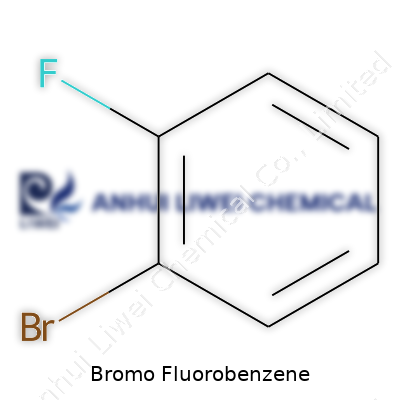
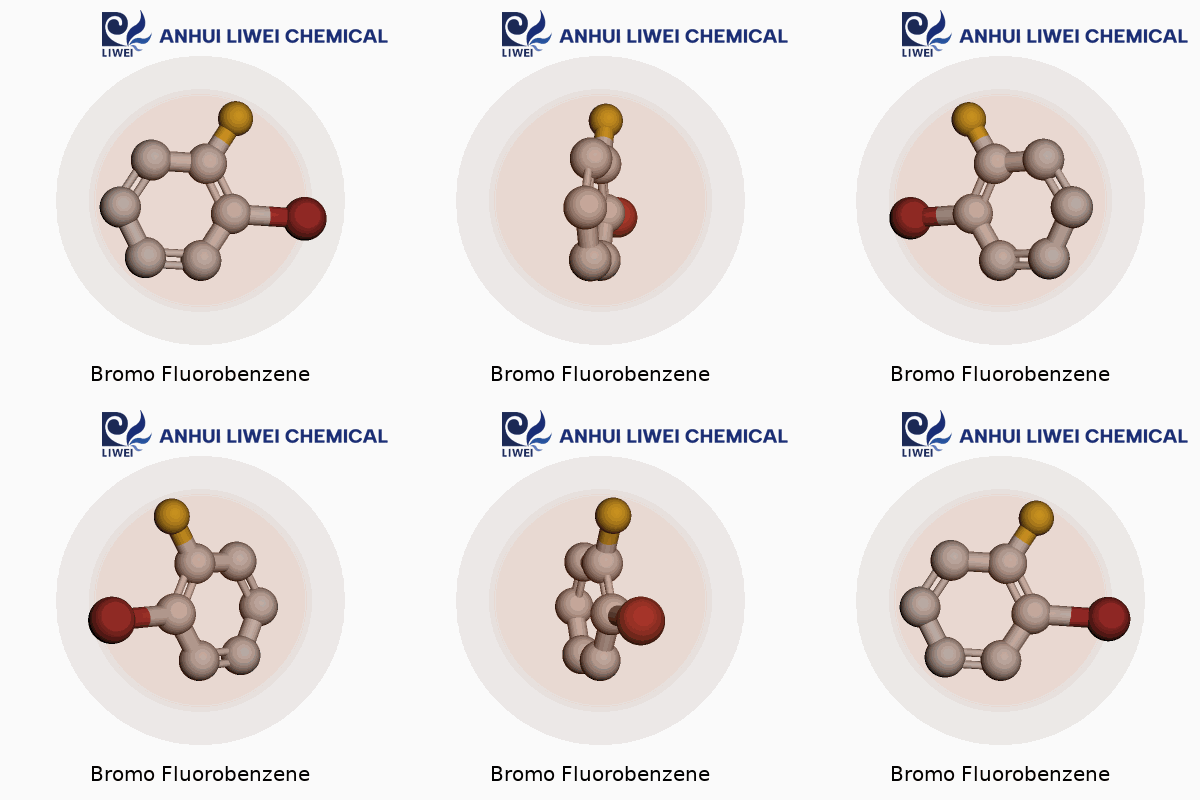
| Names | |
| Preferred IUPAC name | 1-bromo-2-fluorobenzene |
| Other names |
Bromofluorobenzene
Fluorobromobenzene 1-Bromo-2-fluorobenzene 1-Bromo-3-fluorobenzene 1-Bromo-4-fluorobenzene o-Bromofluorobenzene m-Bromofluorobenzene p-Bromofluorobenzene |
| Pronunciation | /ˌbroʊ.moʊ ˌflʊər.oʊˈbɛn.ziːn/ |
| Identifiers | |
| CAS Number | 460-00-4 |
| 3D model (JSmol) | Brc1ccccc1F |
| Beilstein Reference | 1854833 |
| ChEBI | No unique ChEBI ID for Bromo Fluorobenzene; specify isomer. |
| ChEMBL | No unique ChEMBL ID: 'Bromo Fluorobenzene' is ambiguous; specify an isomer. |
| ChemSpider | 9592 |
| DrugBank | No DrugBank entry found. |
| EC Number | 207-304-1 |
| MeSH | Bromobenzenes; Fluorobenzenes |
| PubChem CID | 7670 |
| RTECS number | CY9030000 |
| UNII | V4C8Y2T7X8 |
| UN number | UN1993 |
| Properties | |
| Chemical formula | C6H4BrF |
| Molar mass | 175.00 g/mol |
| Appearance | Colorless to pale yellow liquid. |
| Odor | aromatic |
| Density | 1.593 g/mL |
| Solubility in water | Insoluble in water |
| log P | 3.14 |
| Vapor pressure | 7.5 mmHg |
| Magnetic susceptibility (χ) | -89.4x10^-6 cm3/mol |
| Refractive index (nD) | 1.533 |
| Viscosity | 0.9 cP |
| Dipole moment | 0.1 D |
| Thermochemistry | |
| Std enthalpy of combustion (ΔcH⦵298) | -2971.0 |
| Hazards | |
| GHS labelling | GHS02; GHS07; Warning; H226; H315; H319; H335; P210; P233; P240; P241; P242; P243; P261; P264; P271; P280; P302+P352; P303+P361+P353; P304+P340; P305+P351+P338; P332+P313; P337+P313; P362+P364; P370+P378; P403+P235; P501 |
| Pictograms | GHS02, GHS07 |
| Signal word | Danger |
| Precautionary statements | P210 P233 P240 P241 P242 P243 P261 P264 P270 P271 P280 P301+P312 P302+P352 P303+P361+P353 P304+P340 P305+P351+P338 P312 P321 P330 P332+P313 P337+P313 P362 P363 P370+P378 P403+P235 P405 P501 |
| NFPA 704 (fire diamond) | 2 2 0 |
| Flash point | 62 °C (143.6 °F) |
| Autoignition temperature | 565 °C |
| Explosive limits | 1.4%-8.9% |
| Lethal dose or concentration | LD50: 2700 mg/kg (oral, rat) |
| LD50 (median dose) | 3200 mg/kg |
| NIOSH | No specific NIOSH REL/STEL established for Bromo Fluorobenzene. |
| PEL (Permissible) | No PEL established. |
| REL (Recommended) | Not established |
| IDLH (Immediate danger) | Not established |
| Related compounds | |
| Related compounds |
1-Bromo-2-fluorobenzene
1-Bromo-3-fluorobenzene 1-Bromo-4-fluorobenzene |


