3-Bromopyridine: From Early Chemistry to Future Promise
Historical Development
Chemistry never stops evolving. Back in the early twentieth century, scientists eyed pyridine rings as versatile building blocks for pharmaceuticals and other advanced materials. The journey of 3-bromopyridine began in the labs where simple substitution reactions started to unlock the value of halogenated heterocycles. Researchers soon realized that adding a bromine atom to the pyridine backbone could create a platform for even more ambitious chemistry. Over the decades, 3-bromopyridine found its way from small bottles in research institutions to large-scale production sites as synthetic strategies grew more sophisticated. As teams around the world worked to optimize methods, yields kept improving and the costs dropped, putting this once-niche compound into reach for a wide range of applications.
Product Overview
3-bromopyridine is an aromatic compound featuring a bromine atom attached to the third position of a pyridine ring. Chemists turn to it as both an intermediate and starting material because of its reliability in cross-coupling reactions. Molecular formula C5H4BrN keeps the focus squarely on simplicity and reactivity. In the bottle, the substance appears as a clear to pale yellow liquid. Behind every bottle sits ample utility, serving as the launching pad for making more complex molecules in pharmaceuticals, agrochemicals, and performance materials. It’s a solid bet for folks looking for predictable behavior in demanding synthetic settings.
Physical & Chemical Properties
Key facts show up quickly when handling 3-bromopyridine. The liquid boils at around 195°C, meaning chemists handle it with appropriate cooling or modest vacuum where needed. Specific gravity hovers near 1.6, and it carries that tell-tale, somewhat unpleasant pyridine odor. It dissolves in common organic solvents like ether and chloroform, but prefers to keep its distance from water. The bromine atom throws electronic effects across the ring and makes the compound a solid partner for palladium-catalyzed reactions. Chemists appreciate the stable shelf life under good storage, and there’s limited volatility at normal lab temperatures.
Technical Specifications & Labeling
Bottles roll out of suppliers’ warehouses labeled with purity levels often exceeding 98%, a must-have for research and manufacturing. Labels mark hazard classifications, identify batch numbers for traceability, and highlight any stabilizing additives. Regulatory info in line with GHS standards tracks with modern practice. Storage instructions keep the material away from light and moisture. Barcode systems and QR codes sometimes link users straight to digital technical sheets, making life easier for quality managers and operators tracking chemical inventories over time.
Preparation Method
Producing 3-bromopyridine leans on functional group interchanges, drawing from chromatic lab glassware and moving up to commercial reactors. The classic approach uses direct bromination of pyridine, often with N-bromosuccinimide (NBS) under controlled conditions to aim for substitution at the 3-position rather than elsewhere on the ring. Many chemists favor this route for its selectivity, but some scale-up operations tweak catalyst systems to tamp down unwanted byproducts. Recrystallization and distillation refine the end product, balancing throughput and purity. Over time, more sustainable brominating agents and solvent recovery cycles have come online, giving operators tools to reduce waste and environmental load.
Chemical Reactions & Modifications
In the toolbox of synthetic chemistry, 3-bromopyridine earns its keep mainly in cross-coupling reactions. The C–Br bond opens the door for Suzuki, Stille, and Heck reactions, letting chemists swap in aryl or alkyl groups with high reliability. Nucleophilic substitutions create further diversity after transition-metal catalysis initiates the transformation. Grignard reagents turn up as partners where carbon-carbon bond formation needs precision. Protecting groups and ring-opening reactions also find a strong ally with the bromo handle. Over and over, the bromine acts as a passport to new structures, quietly doing the hard work of unlocking molecular complexity.
Synonyms & Product Names
Chemical catalogs rarely stick to a single name. 3-bromopyridine can also turn up as m-bromopyridine, pyridine-3-bromide, and even 3-pyridinyl bromide. Different suppliers use their own product codes, sometimes incorporating batch numbers for pharma clients requiring full traceability. All these names nod back to the location of the bromine atom, making it clear just what’s inside the bottle regardless of branding strategy or regional language quirks.
Safety & Operational Standards
Chemists can’t ignore the health and safety profile of 3-bromopyridine. Gloves, goggles, and fume hoods stay in regular use because the compound emits noticeable vapors and shows irritant effects on skin and eyes. Safety data sheets from trusted sources spell out emergency procedures, including first aid steps and spill response. Labs and manufacturing sites adopt written SOPs covering every touchpoint from delivery to waste disposal. Local and international shipping rules, including UN guidelines for hazardous materials, add another layer of oversight. The material’s flammability and potential toxicity mean it rides along with color-coded hazard labels and secure, vented secondary containers.
Application Area
Pharmaceutical research draws the most attention, relying on 3-bromopyridine as a substrate in the creation of targeted drugs. Anti-cancer and antiviral candidates often include a substituted pyridine core, and process chemists find 3-bromopyridine invaluable for modular synthesis and late-stage functionalization. Agrochemical developers also adopt the compound when screening for new insecticides and herbicides. Materials scientists find new uses as bromo-substituted pyridines grow into advanced polymers and performance coatings. In academic circles, it stands as a benchmark in methodology papers testing new catalyst systems.
Research & Development
Industrial R&D teams continue to hunt for greener synthesis paths and better scalability. Labs report improved yields through microwave heating, continuous-flow reactors, and cleaner work-up steps. Teams looking to minimize environmental impact experiment with recyclable catalysts and alternative solvents. Predictive software models now help researchers design and optimize routes before anyone breaks out the glassware. Universities explore the limits of reactivity, demonstrating how 3-bromopyridine can anchor bioactive molecules for diagnostics, imaging, and new forms of catalysis.
Toxicity Research
Toxicologists catalog both the acute and chronic effects of exposure. Animal studies flag the irritant action on respiratory tissues and the risk of systemic absorption after prolonged skin contact. Metabolic breakdown in mammals produces several pyridine metabolites, and regulatory groups keep an eye on potential neurotoxicity. Routine assays measure LD50 values and look for genotoxic markers. Waste handlers rank the compound as a moderate hazard, calling for incineration or advanced solvent recovery instead of casual drainage. Environmental persistence gets attention, as 3-bromopyridine may carry a mild risk if released into waterways without treatment. Regulators urge prudence and seek robust data to inform occupational exposure limits.
Future Prospects
Looking ahead, the value of 3-bromopyridine likely keeps rising. The flood of interest in new drug discovery, combined with the appetite for greener processes, pushes this bromo-arene into the spotlight. Startups and established firms seek efficient, waste-minimized syntheses and more robust recycling strategies. Digital tracking and in-line monitoring promise better safety compliance and quality metrics from bench to kilogram scale. Automated process platforms stand ready to integrate even more advanced, data-driven chemistry. In universities and industry alike, 3-bromopyridine will keep showing up in patents, publications, and—most importantly—as part of medicines that matter to patients worldwide.
The Backbone of Innovative Molecules
Anyone who has ever worked in a chemistry lab knows that small molecules can carry a lot more weight than their size suggests. 3-Bromopyridine falls into this camp. At first glance, it’s just a pyridine with a bromine attached, but beneath that simplicity lies some eye-opening potential. The world of pharmaceuticals, agrochemicals, and advanced materials all draw from this compound, turning to it time and again as a crucial building block.
Bridging Research and Real-World Applications
It’s easy for product labels to run together—active ingredients, solvents, binders—but what doesn’t show up on packages fuels the whole process. 3-Bromopyridine sits right there, smack in the middle of chemical synthesis. It isn’t a household name, but it’s probably in the background of numerous household products thanks to where it leads.
Researchers reach for 3-Bromopyridine to craft new molecules that might never come into existence otherwise. This compound acts as a starting point for making more exotic derivatives, bringing flexibility and precision to the design of pharmaceutical candidates. You need specific reactions to control where a new chemical group will land on a pyridine ring—3-Bromopyridine helps lock that down. For chemists, this specificity means time saved, fewer headaches, and a shot at some much-needed breakthroughs.
Lighting Up Pharmaceutical Discovery
Drug discovery runs on small improvements: a little more activity, a tad less toxicity, better absorption. Pyridine rings show up over and over in medicine because they strike a sweet spot between reactivity and stability. Adding a bromine at the 3-position, as in 3-Bromopyridine, gives research teams the perfect launchpad.
Big names like Pfizer, Roche, and Novartis frequently turn to bromopyridine cores for antiviral, anticancer, or neurological drug candidates. The pharmaceutical libraries built from starting compounds like this one don’t just add to science—they change lives. The magic lies in the functionalization. With 3-Bromopyridine, cross-coupling reactions like Suzuki and Negishi transformations become a lot smoother. These reactions open dozens of doors for introducing variety in a molecule’s structure, helping researchers push medicines from the laboratory benchtop to a patient’s treatment plan.
Fine Chemicals and Everyday Products
The story doesn’t stop at medicine. Crop protection is another major area. Farmers fight weeds, insects, and fungi with tools born from years in the lab. Certain herbicides and fungicides trace their roots back to molecules built up from 3-Bromopyridine. Efficiency in production and reliable selective action both depend on starting with a trusted intermediate.
In the world of materials, this compound sets the stage for specialty polymers and liquid crystals. Displays and coatings that keep devices looking sharp and functioning properly often involve complex organic syntheses that lean on intermediates like 3-Bromopyridine. As technology grows more demanding, so do the routes for manufacturing these materials.
Ensuring Safety and Responsibility
No chemical comes free of risks. Working with brominated compounds takes caution, both for lab workers and for waste management. Rigorous protocols, thorough education, and transparent reporting all form the backbone of responsible use. Regulatory bodies such as the EPA and European Chemicals Agency keep a close eye on compounds that could leave a mark outside the research lab.
Looking forward, the challenge becomes balancing scientific freedom with responsibility toward health and the planet. By emphasizing greener synthesis methods and supporting robust supply chain transparency, research communities can continue turning 3-Bromopyridine’s promise into tangible benefits—without leaving hazards for others to clean up.
3-Bromopyridine: More Than Just a String of Letters
Chemistry class might seem a world away for most people, but every day, we come across substances that play serious roles in industries, labs, and even in our homes. Let’s dig into what makes 3-bromopyridine distinctive. Its chemical formula sits out there as C5H4BrN, putting carbon, hydrogen, bromine, and nitrogen in a tight little package.
Reading the Formula
If you’ve ever held a bottle in an organic chemistry lab marked “3-bromopyridine,” seeing C5H4BrN on the label gives instant clues about the molecule’s skeleton. Chemists know straight away: five carbons and a nitrogen form the pyridine ring. Add four hydrogens—proving that the base ring’s backbone isn’t overloaded with bulky groups. The bromine at the third position draws sharp distinction from relatives like 2- or 4-bromopyridine.
Knowing the Structure Matters
It sounds basic, but a shift in a single atom’s position can make a world of difference. 3-Bromopyridine holds a special place in drug development and materials research. With my years working in a research lab, recognizing such subtle variations often meant the difference between a reaction failing or succeeding. In pharmaceutical synthesis, the location of bromine opens routes to new molecules, especially through metal-catalyzed couplings.
Why Fact-Checking the Formula Makes Sense
There’s no sense in getting experimental results only to realize the chemical on your bench isn’t what you thought. Mix-ups happen. One co-worker of mine grabbed a different isomer and lost two days chasing a reaction that refused to work. Cross-referencing formulas and double-checking bottles saves headaches. Companies lean on tight fact-checking to keep their supply chains straight, too. Chemical suppliers rely on precise labeling—misidentifying a formula could lead to regulatory troubles, lost revenue, or even dangerous mistakes.
Experience and Trust: Why E-E-A-T Principles Count
Looking at a chemical formula like C5H4BrN, it’s not just about having the right letters and numbers. E-E-A-T—Experience, Expertise, Authority, and Trust—really comes into play here. Chemists pull from both book knowledge and hands-on work to recognize what C5H4BrN means in the broader context. Trust in a label starts with trust in the lab or supplier who put it there. When sourcing chemicals or designing synthesis plans, I never settled for less than full transparency from suppliers—knowing exactly what’s in a bottle keeps work reliable and safe.
The Push Toward Reliable Chemical Information
Plenty of open-access databases now provide up-to-date chemical information—think PubChem or ChemSpider—with chances for scientists to compare notes. Clear chemical identifiers help ensure everyone’s talking about the same substance. Many labs now require two sets of eyes on crucial labels, especially for chemicals used in high-stakes pharmaceutical research.
Finding Solutions for Chemical Clarity
Building better digital databases with images, labels, and supplier links grows chemical transparency. Open communication between manufacturers, distributors, and end users helps dodge mishaps. I’ve found that regular training for lab staff—knowing how to cross-check a formula on a label with a reliable reference—pays off in real-world chemistry. Pushing for these standards means safer, more effective discoveries, whether you’re in a teaching lab or a cutting-edge biotech startup.
A Closer Look at Toxicity
3-Bromopyridine might sound like just another chemical with an odd name, but if you work around labs or in pharmaceutical manufacturing, you probably know its sharp, bitter scent lingers. This chemical helps build complex molecules for drugs and agricultural products—it plays a behind-the-scenes role in some of the medicines people rely on. The big question: Is it hazardous or toxic?
Understanding the Risks
Several studies classify 3-bromopyridine as an irritant. Direct contact with skin stings; inhalation burns the nose and throat. I’ve seen colleagues wearing face shields and gloves every time they handle it, and there’s good reason for that. Pyridine rings and brominated chemicals have a reputation—enough accidents over the years have taught labs to respect compounds like this.
The Material Safety Data Sheet (MSDS) stands firm on all precautions: 3-bromopyridine may cause acute symptoms—think nausea, headache, coughing, shortness of breath—if vapor escapes during handling. Even small spills demand quick cleanup because this stuff seeps into surfaces and leaves a strong odor. It’s tough to forget those days after a minor flask mishap left the whole lab smelling awful until the ventilation kicked in.
Long-Term Health Effects
There isn't a mountain of long-term human data, but repeated exposure to related chemicals has caused problems for workers over the years. Chronic contact can dry out skin and trigger respiratory issues. The chemical structure includes bromine, which often brings extra reactivity and, with pyridine, volatility. Animal tests point out the risk for organ damage with significant exposure, although the numbers needed for this are more than anyone would casually handle.
Environmental Impact
Waste from 3-bromopyridine doesn't vanish once down the drain. Most industrial labs now collect contaminated solvents for special disposal. This isn’t just bureaucracy—runoff can poison water supplies and harm wildlife if it leaks into the wider environment. The Environmental Protection Agency lists pyridine derivatives as potential contaminants, so proper disposal really matters.
What Can Make Handling Safer?
Personal experience matches the science—those gloves and fume hoods exist for a reason. Labs have moved to tight-lidded containers and better air filtration over the years. Spills aren’t handled alone; teams train for quick, coordinated cleanup. I once saw a newcomer hesitate to use the full respiratory mask, thinking a quick pour posed little risk. A single cough changed his approach forever.
It’s worth considering alternatives, too. Some labs switch to less hazardous coupling agents or explore green chemistry methods that cut out problematic intermediates. Finding new routes for old reactions isn't easy, but reducing exposure helps everyone. Government regulations push for lower exposure limits every few years as knowledge grows. Ensuring regular safety training and up-to-date protocols may not seem exciting, but it keeps people healthy and the workspace safe.
Why Awareness Matters
In labs, taking shortcuts with compounds like 3-bromopyridine invites trouble. It's not about needless fear; it’s about respect for chemistry’s power. The facts are clear: this is a useful but risky tool. Safe habits, careful disposal, honest communication, and serious attention to safety gear protect everyone around. From experience, vigilance trumps regret every time.
The Science Behind a Number
Ask any chemist about 3-bromopyridine and you’ll often see them reach for a reference book or database. The boiling point? Clocking in at around 204-206°C under normal atmospheric pressure. That figure comes as the result of hands-on lab measurements and plenty of shared experience across research teams. This isn’t just trivia: knowing when a compound like 3-bromopyridine changes from liquid to vapor sets the stage for safe handling, proper storage, and reliable results in synthesis work.
Beyond the Textbook
Sitting at the intersection of organic chemistry and real-world application, compounds like 3-bromopyridine find a home in pharmaceutical research, crop science, and even material development. From time spent in research environments, it becomes clear that a single number on a safety sheet can mean the difference between a ruined batch and a successful experiment. Imagine trying to distill or purify a batch of chemicals with the wrong temperature settings—a mistake here usually spells wasted time, lost resources, and potential danger.
Boiling Point: A Clue to Stability
The boiling point does more than set a physical limit for heating. It signals a compound’s volatility and helps forecast its behaviors during reactions or manufacturing. With 3-bromopyridine, the relatively high boiling point compared to lighter organics means less worry over evaporative loss during standard handling. That reassurance grows important in tight lab quarters, where every milliliter counts—and where inhalation of vapors is always best avoided.
From personal experience tracking down elusive starting materials, I’ve seen how a solid understanding of boiling point smooths out safety planning. Labs using 3-bromopyridine routinely refresh their safety protocols, leaning on knowledge rooted in solid numbers. Material safety data sheets point to improper heating as a common cause of lab mishaps. Respect for the boiling point translates into well-chosen glassware and spot-on heating profiles during reactions or column work.
Why Accuracy Matters
Researchers and industrial chemists trust published boiling points, but not every figure online carries equal weight. Discrepancies crop up when sources misreport or round off data, leading to confusion, especially for those scaling up processes. Most reliable sources—Merck, PubChem, Sigma-Aldrich—narrow down boiling point to 204-206°C, confirmed through both experimentation and peer review. Consistency here matters because product quality, reproducibility, and, ultimately, safety ride on that precision.
Pushing for Safety and Innovation
In larger facilities, that number guides the choice of equipment and helps maintain regulatory compliance. Workers need to know which spirits are likely to off-gas, create pressure, or require scrubbers to keep air standards healthy. In smaller outfits or academic labs, the right use of the boiling point brings confidence to students just learning their way around volatile compounds. I’ve seen new researchers relax a little once they trust the data—the first step toward creative experimentation is knowing your risks.
A Path Forward
Better awareness comes through ongoing education and accessible, verified chemical data. Open-access databases and robust lab training go hand in hand. Encouraging more hands-on instruction in chemical handling—rather than just theory—cements good habits, especially where substances like 3-bromopyridine play a daily role. Digital catalogs and universal standards push for fewer surprises, more accountability, and safer, more efficient labs in every corner of science and industry.
Why Proper Storage Matters
3-Bromopyridine carries a reputation in labs for being a strong-smelling, reactive compound. It finds its use in pharmaceutical research and as a synthetic building block. This chemical demands more than the usual caution because of its volatility and how it interacts with air and moisture. Mishandling can lead to ruined batches, exposure to fumes, or, in the worst scenario, a lab safety incident.
Choosing the Right Container
Most people who work with chemicals develop a healthy respect for good containers. Glass offers the safest bet for most organic chemicals, and 3-Bromopyridine is no exception. Plastic can react with some brominated organics or allow fumes to escape, which exposes handlers to irritants and threatens the sample's purity. I’ve seen someone try to cut corners and pour it into an old, ill-fitting plastic bottle; the result was a stinky mess and wasted product.
A well-sealed, airtight glass vial with a PTFE (Teflon) lining stands up to 3-Bromopyridine’s tendency to seep fumes. With the right closure, the risk of evaporation, leaks, and cross-contamination drops, and the distinctive odor doesn't escape into the storage cabinet.
Temperature and Environmental Factors
Experience teaches that organic chemicals rarely like heat, humidity, or sunlight, and 3-Bromopyridine acts just as finicky. Room temperature can work if the chemical doesn’t sit near windows or radiators—sunlight speeds up decomposition and can even trigger side reactions you might only spot during experiments. Lab refrigerators set to about 4°C slow down degradation and keep the material usable for much longer. If you have the luxury of a flame-proof fridge, use it. Just don’t stick it in a kitchen-style fridge that shares space with food—you won’t appreciate the lingering smell, and it poses contamination issues.
Moisture presents another risk. Direct exposure to humid air may alter 3-Bromopyridine over time, degrading purity. I’ve found that adding desiccant packs to the storage location, whether in a coolant-safe box or chemical storage closet, keeps that from happening.
Preventing Accidents
Lab safety officers always push secondary containment—and with good reason. Having 3-Bromopyridine stored inside a secondary container or chemical-resistant tray makes cleanups easier if a vial leaks or breaks. Leak-proof trays add another line of defense if your bottle gets knocked over.
Checking labels goes a long way, too. Permanent, clear labeling helps prevent mix-ups, especially for partially used bottles. Misidentification ranks high on the list of rookie mistakes that have dangerous or expensive consequences.
Anyone handling 3-Bromopyridine should already know to work in a fume hood and keep incompatible materials far apart. Brominated organics react badly to oxidizers and strong acids. Keeping a material safety data sheet (MSDS) handy gives you recourse if questions come up or something unexpected occurs.
Best Practices Go Beyond Storage Alone
It takes a blend of training, well-ventilated workspace, and clear operating procedures to keep risks down. Storing 3-Bromopyridine in the right spot doesn’t just protect the chemical; it also shields everyone in the lab from potential harm. Recognizing and respecting the hazards brings peace of mind and helps keep science running smoothly day after day.
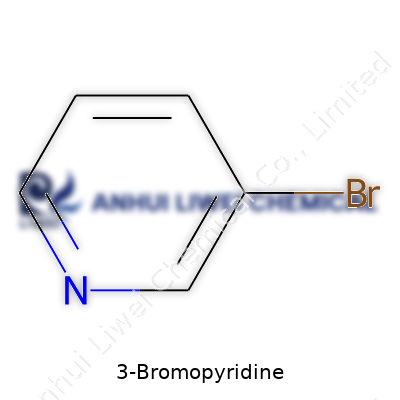
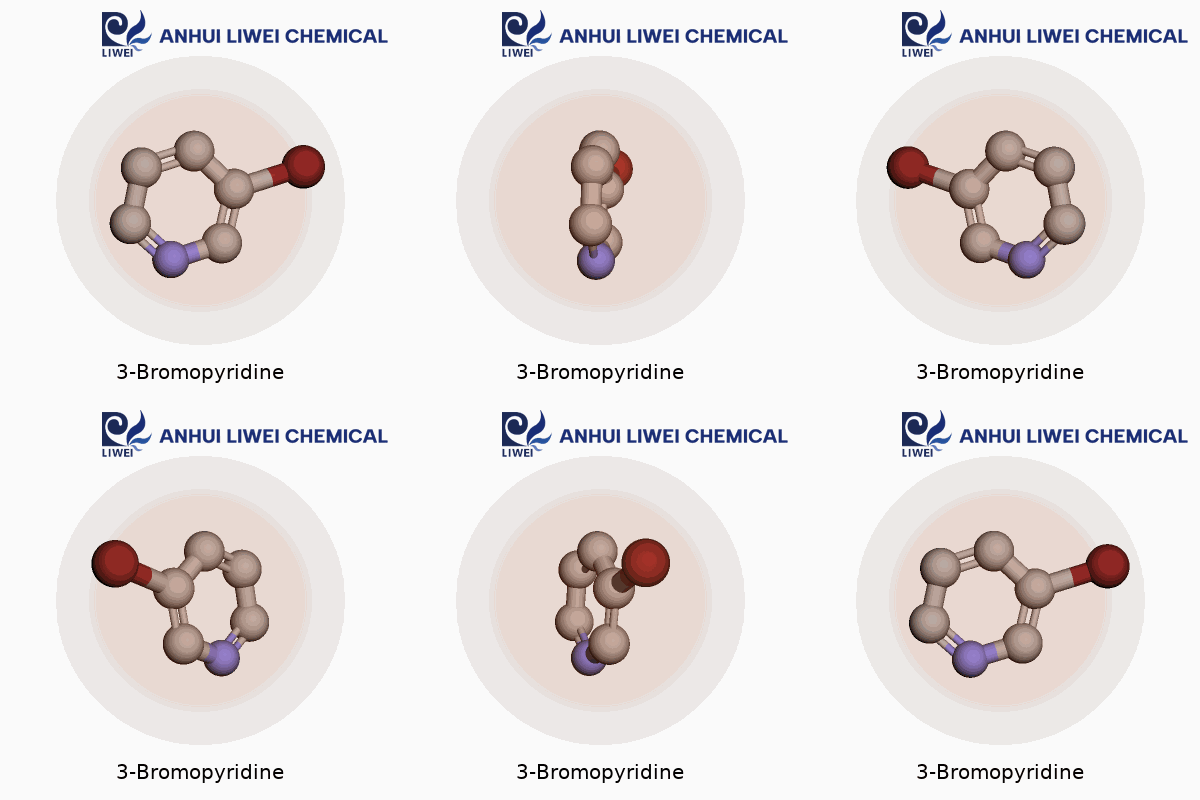
| Names | |
| Preferred IUPAC name | 3-bromopyridine |
| Other names |
3-Pyridyl bromide
m-Bromopyridine β-Bromopyridine Pyridine, 3-bromo- |
| Pronunciation | /θriː ˌbrəʊ.məʊˈpɪr.ɪ.diːn/ |
| Identifiers | |
| CAS Number | 626-55-1 |
| 3D model (JSmol) | Brc1cccnc1 |
| Beilstein Reference | 105691 |
| ChEBI | CHEBI:51450 |
| ChEMBL | CHEMBL145697 |
| ChemSpider | 21389 |
| DrugBank | DrugBank: Not found |
| ECHA InfoCard | 100.010.953 |
| EC Number | 210-953-6 |
| KEGG | C14481 |
| MeSH | Pyridines |
| PubChem CID | 78973 |
| RTECS number | UU5950000 |
| UNII | '8N6F5E4X8V' |
| UN number | 2810 |
| Properties | |
| Chemical formula | C5H4BrN |
| Molar mass | 157.998 g/mol |
| Appearance | Colorless to light yellow liquid |
| Odor | pungent |
| Density | 1.64 g/mL |
| Solubility in water | Slightly soluble in water |
| log P | 1.62 |
| Vapor pressure | 2.5 mmHg at 25 °C |
| Acidity (pKa) | 2.85 |
| Basicity (pKb) | 11.16 |
| Magnetic susceptibility (χ) | -75.6×10^-6 cm³/mol |
| Refractive index (nD) | 1.5680 |
| Dipole moment | 2.0 D |
| Hazards | |
| Main hazards | Main hazards: Harmful if swallowed, causes skin and eye irritation, may cause respiratory irritation. |
| GHS labelling | GHS02, GHS07, Warning, H226, H302+H312+H332, H315, H319, H335, P210, P233, P240, P241, P242, P243, P261, P264, P270, P271, P280, P301+P312, P302+P352, P304+P340, P305+P351+P338, P312, P330, P332+P313, P337+P313, P362+P364, P403+P233, P405, P501 |
| Pictograms | GHS07 |
| Signal word | Warning |
| Hazard statements | H226 H302 H312 H315 H319 H332 H335 |
| Precautionary statements | P261 P264 P270 P271 P280 P301+P312 P302+P352 P304+P340 P305+P351+P338 P312 P330 P332+P313 P337+P313 P362 P403+P233 P405 P501 |
| NFPA 704 (fire diamond) | 2-2-0 |
| Flash point | 51 °C |
| Lethal dose or concentration | LD50: 200 mg/kg (rat, oral) |
| LD50 (median dose) | 352 mg/kg |
| PEL (Permissible) | No PEL established. |
| REL (Recommended) | Not established. |
| Related compounds | |
| Related compounds |
2-Bromopyridine
4-Bromopyridine Pyridine 3-Chloropyridine 3-Fluoropyridine 3-Iodopyridine 3,5-Dibromopyridine |


