1-Chlorodecane: Substance Overview and Evolving Role
Historical Development
Chemists have had their sights on alkyl halides like 1-Chlorodecane for well over a century. Mankind’s tinkering with long-chain chlorinated hydrocarbons traces back to the rise of organic chemistry in the late 19th century. Pioneers shaped the industrial use of these compounds as they searched for stable, reactive building blocks. During those years, fewer worries circled around environmental impact and worker safety, so research advanced quickly. Use of these chemicals grew alongside petroleum refining and the spread of plastics. Over time, greater scrutiny on toxicity and persistence in nature led labs to improve production control, and regulations grew tighter, especially after the 1970s chemical safety movements. Manufacturers invested in cleaner synthesis, tighter containment, and careful waste disposal. Modern producers keep thorough records, guided by rules and an understanding of past lessons.
Product Overview
1-Chlorodecane, with its ten-carbon backbone and terminal chlorine, often draws attention among the straight-chain chlorinated solvents and intermediates. Its chemical formula, C10H21Cl, doesn’t quite reveal its potential, but those familiar with alkyl chlorides recognize its ability to serve as a reactive partner in organic synthesis. This compound finds a spot on select supply lists for specialty chemical producers, reagent suppliers, and labs focused on surfactants or specialty lubricants. Professionals handling 1-Chlorodecane keep watchful eyes on purity and unwanted byproducts, especially since many downstream applications depend on a clean, well-characterized input. From laboratory benches to pilot-scale plant runs, detail-minded teams keep this compound moving through the pipeline.
Physical & Chemical Properties
1-Chlorodecane, at room temperature, stays a colorless liquid. The scent? Think faint sweet and somewhat medicinal, typical of medium-chain chlorinated hydrocarbons. The boiling point sits around 215 to 220°C, noticeably higher than many solvents but still workable for general lab glassware. This liquid weighs less than water, floats on top if you try to mix them, but its moderate solubility in alcohols and ethers lets it fit into a range of chemical prep work. Chemically, the terminal chlorine atom stands as the site of action, primed for substitution with nucleophiles, reduction or elimination. The longer alkyl tail tugs the balance toward oil-loving environments, where it glides through nonpolar solvents and interacts well in organic matrices, especially in modified surfactants and oils.
Technical Specifications & Labeling
Producers supply 1-Chlorodecane in tightly sealed metal drums or amber glass jugs, always marked with hazard symbols reflecting both flammability and toxicity. Typical high-purity standards demand greater than 98% assay by gas chromatography and strict limits on water, acid, and iron content. Professionals handling drums check labels for batch numbers, supplier contact information, and recommended storage temperatures, often around 15–25°C. Proper technical documentation keeps traceability in the spotlight, meeting the expectations drawn from chemical management frameworks like GHS. Safety Data Sheets remain close at hand for all handlers, spelling out both chemical and physical hazards.
Preparation Method
Producers draw on a well-known method—treating 1-decanol with a chlorinating agent like thionyl chloride, phosphorus trichloride, or phosphorus pentachloride. This substitution paves the way toward selective product formation, but details matter. The choice of solvent, reaction temperature, and work-up conditions affect the chlorination efficiency and final product purity. Water exclusion stands as a non-negotiable; even small leaks or poorly dried glassware lead to hydrolysis or byproduct formation. Many companies run these steps in closed reactors fitted with proper venting, then draw the crude mixture through water washing and distillation. Behind that seemingly simple recipe lies a world of hands-on craft—good lab folks know a clean reaction line and precise temperature readings steer the process toward readable GC traces and less scrapped material.
Chemical Reactions & Modifications
The terminal chlorine atom in 1-Chlorodecane readily invites exchange with stronger nucleophiles. Typical reactions involve swapping the chlorine for azide, cyanide, or amine groups, offering routes into pharmaceuticals, agrochemicals, and tailored surfactants. Reduction under proper conditions kicks out the chlorine entirely, giving n-decane, a useful hydrophobic scaffold. Under base, elimination reactions yield decenes, opening doors to further functionalization. In research, 1-Chlorodecane acts as an alkylating agent, stretching chains or introducing hydrophobicity into larger molecules. Polymer chemists sometimes tether it to backbones for property control or to create block copolymers with controlled release characteristics.
Synonyms & Product Names
In catalogs, buyers encounter alternate names: Decyl chloride stands most common, but others include n-Decyl chloride, 1-Decyl chloride, or the less frequent NCI-C60717 (out of older registration systems). Chemdex, Sigma-Aldrich, and Lab Alley keep similar prefixes, sometimes listing by IUPAC or by trade name depending on supply region. This diversity reflects how chemical commerce grew from local supply houses to today’s global, highly regulated networks. Anyone procuring the compound for industrial, research, or teaching uses checks CAS Number 112-85-6 to avoid ambiguity.
Safety & Operational Standards
Safe use of 1-Chlorodecane demands careful attention and solid procedures. Storage outside direct sunlight and away from heat sources or oxidizers stands as standard practice. Direct contact can irritate skin and eyes; inhalation of vapors causes headaches and nausea, even at moderate levels. Facility teams install fume hoods for open transfers, back that up with chemical-resistant gloves, goggles, and lab coats. Training drills reinforce quick spill cleanup without water, using inert absorbents for containment. Fire plans address both flammability and the risk of toxic hydrogen chloride fumes in the event of combustion, so workers keep carbon dioxide or dry-chemical extinguishers close. Regular audits keep shelves stocked with the right PPE, with incident logs checked against global health guidance from OSHA and the European Chemical Agency.
Application Area
Industry deploys 1-Chlorodecane as more than a synthetic curiosity. Surfactant manufacturers covet its straight chain for customized detergents, especially for fine-tuning wetting and emulsifying properties in cleaning products and coatings. Lubricant engineers use it as a blending agent or intermediate, improving viscosity and temperature stability. Material scientists working on self-assembling monolayers grab it for building hydrophobic coatings on metals or semiconductors. Some sectors explore its performance as a phase change material or in drag-reducing agents. More specialized uses creep into pharmaceutical and agrochemical development, especially during lead optimization for compounds needing precise side-chain length control.
Research & Development
Ongoing research probes 1-Chlorodecane’s role in surface science and controlled-release formulations. Academic groups lean on it when designing novel nanoemulsions, stretching boundaries in drug delivery and sensor technology. Newer catalysis techniques aim to replace traditional chlorination agents with greener alternatives, reducing waste and improving yields. Patent filings suggest continuing innovation in lubricant formulation where chain-specific halides matter for performance at temperature extremes or high pressure. Cross-disciplinary collaborations between synthetic chemists and process engineers keep yields climbing and energy use dropping, meeting the call for more sustainable chemical manufacturing.
Toxicity Research
Researchers recognize the acute and chronic risks tied to chlorinated hydrocarbons. Studies on 1-Chlorodecane point to moderate skin and eye irritation, with possible liver and kidney effects in lab animals after repeated exposure. Data show metabolic breakdown to decanol and chloride in mammals, sparking interest in the long-term implications for workers. Regulators in the US, EU, and Japan keep exposure limits tight, reflecting experience with related substances. Toxicologists call for new analytical tools to track workplace exposure and conduct real-time air monitoring. Stakeholders demand updates to Safety Data Sheets as evidence accumulates, putting transparency at the center of handling practices.
Future Prospects
Economic drivers keep 1-Chlorodecane in play, but technical progress shapes where it fits next. Companies look past older, hazardous syntheses toward cleaner, biobased starting materials. Project leaders invest in continuous flow reactors for lower emissions and finer control. Downstream, demand for custom surfactants and specialty polymers grows, carrying the need for chain-specific intermediates. Regulatory pressure and customer demand for environmentally friendly formulations push industry to redesign processes or find substitutes. Research teams dive deeper into structure-activity relationships, hoping to refine which side-chains deliver the best performance without environmental baggage. Product stewardship grows ever more visible, with supply chains tracking cradle-to-grave footprints—showing how chemical manufacturing keeps learning, adapting, and recalibrating in the face of tougher global standards.
Looking Past the Lab Bench
Growing up around people who worked in the chemical industry, bottles of odd liquids sat in garages, sometimes with warning labels I couldn’t read. That’s how I first saw a vial labeled 1-Chlorodecane. Most people don’t bump into this stuff, unless their lives twist through university labs or industrial plants. On the surface, 1-Chlorodecane looks like any other clear, oily liquid. What it lacks in flash, it makes up for in quiet impact in a handful of specialized fields.
Behind the Chain: What Is It?
1-Chlorodecane is an organic compound—ten carbons long, with a chlorine atom attached at the end. It’s one of those straight-chain chlorinated hydrocarbons you stumble across in organic chemistry. Think of it as a building block, set apart by that chlorine, which changes how it reacts and how people use it.
Industrial and Chemical uses
In my own experience, the real draw for 1-Chlorodecane comes at the point where you want to make something bigger. It often plays a role as an intermediate. Manufacturers reach for it to create other chemicals, especially those needed for making surfactants, lubricants, or specialty solvents. It’s earned its place as a starting material that helps piece together ingredients for products we overlook daily.
The oil and gas industry also puts it to work as a solvent. Drilling fluids need to keep their chemistry stable under tough conditions. 1-Chlorodecane offers just the right properties—thermal stability, resistance to breakdown, and it can help carry additives into places no water-based mixture could manage. Taking into account its characteristics, it sometimes shows up when basic hydrocarbons won’t cut it.
Lab research relies on this compound too. Researchers studying organic reactions turn to it when they need a specific reactivity profile, or when they’re mapping out reaction pathways for new molecules. Without chemicals like this, new drugs or materials would arrive on the market much more slowly.
Concerns and Hazards
Anyone who’s spent time near strong-smelling chlorinated compounds knows why there’s caution tape. Exposure brings health risks. 1-Chlorodecane can act as a skin and eye irritant. Inhalation in closed environments sometimes leads to headaches, nausea, or worse symptoms if safety checks fall short. I learned from a young age that you always respect the process—ventilation, gloves, and safe handling matter far more than speed or shortcuts.
Disposing of chemicals can’t be an afterthought. Improper dumping leads to soil and water contamination, hurting both workers and nearby communities. The backyards where I played as a kid taught me the value of environmental vigilance. Companies shoulder a responsibility: managing spills, monitoring emissions, and following disposal protocols. These efforts can’t slip because the price gets paid somewhere, often by people who never saw the original shipment.
Safer Alternatives and the Push for Green Chemistry
Some chemists now search for less harmful replacements. Demand for greener chemistry pushes research labs and factories to limit chlorinated emissions and hunt for biodegradable options. For now, 1-Chlorodecane sticks around where nothing else fits the task, but there’s a constant lean toward better health and environmental outcomes. Investing in safer practices, researching new processes, and listening to front-line workers will do more than any one-time fix. Responsible use matters as much as innovation.
Understanding What You're Handling
Working with chemicals like 1-Chlorodecane isn’t something most people line up for, but jobs in labs and certain industries put it right in front of you. 1-Chlorodecane may sound fancy, yet it’s basically an oily, clear liquid that gives off a strong odor, and it can soak through skin or make your lungs ache if you don’t respect it. I remember the first time I dealt with chlorinated alkanes—one stray splash, and you learn to stop cutting corners about gloves and goggles.
Watching for Health Hazards
Skin gets the brunt of exposure, so nitrile gloves—not the cheap, see-through kind—block the liquid. Splash goggles shield the eyes. Labs carry chemical-resistant coats, but loose sleeves catch spills, so snug fits beat flowing ones. If the air gets thick with fumes, ventilation matters most. Fume hoods earn their keep when vapor rises; folks handling these chemicals in poorly ventilated spaces find out fast that headaches and nausea aren’t rare. It helps to know that inhaling these vapors too long sends you home with a cough or worse, so exhaust fans stay on no matter how quick the job.
Fire Risks Aren’t a Joke
1-Chlorodecane doesn’t light up like gasoline, but calling it “non-flammable” is shortsighted. Heat up the workspace or work near ignition sources, watch the fire risk rise. Most of us keep a dry chemical extinguisher close, since water won’t cut it. When storing, steel drums or bottles with tight-fitting caps limit spills and block fumes from sneaking out. I learned early—never keep rags soaked in chlorinated solvents lying out. A tiny spark could mean disaster.
Dealing with Spills and Disposal
Wipe up a small spill right away, but never with bare hands—disposable absorbent pads go down first. Open a window or kick up the fume hood for bigger messes, and don’t forget that regular trash isn’t an option. My team uses dedicated bins with chemical-resistant liners, shipped off by licensed waste handlers, since dumping this stuff down the drain will land you in real legal trouble. Service records show proper tracking—a must for audits or inspections.
Staying Prepared with Training and Information
No fancy talk here: relying on memory alone doesn’t cut it. We keep Safety Data Sheets (SDS) posted and visible because panic doesn’t leave time for searching through paperwork. Training matters just as much. Anyone working with 1-Chlorodecane should know what symptoms to watch for, where safety showers stand, and whom to call if things go sideways. In my experience, mock drills make folks less likely to freeze up during a real emergency.
Better Habits, Fewer Accidents
Respecting chemicals like 1-Chlorodecane protects the entire team. Industry data from OSHA shows injuries drop in workplaces where folks don’t brush off the basics. Swapping stories about close calls in the break room sets examples the new hires actually remember. Simple steps—gloves, goggles, good airflow, and proper disposal—take effort, but everybody goes home safe when no one cuts corners.
1-Chlorodecane: Structure and Significance
Focusing on 1-Chlorodecane brings us down to the world of organic chemistry—a place where a small tweak in an atom’s placement changes a molecule’s job and, sometimes, its reputation. The chemical formula for 1-Chlorodecane is C10H21Cl. This tells us there are ten carbon atoms lined up in a chain, bonded to twenty-one hydrogens, and then, at the very end, one hydrogen swaps out for a chlorine atom. The “1-” in its name points to the fact that chlorine claims its spot at the first carbon, which matters more than it may look. Swapping chlorine to a different spot nudges the whole molecule into a new lane, changing how chemists and industry folks use it.
Why Knowing the Formula is Useful
Having spent years paging through textbooks and later leading students through organic chemistry, I realized plenty of people ask about formulas like this for a reason. Sometimes, a straightforward answer helps demystify paths in laboratories or guide production in factories. Knowing 1-Chlorodecane’s formula means people can predict how it behaves in a reaction—the boiling point, the likely smell, maybe even how easily it slips through skin or mixes with water. Compared to decane, slipping in just one chlorine makes the whole molecule a bit heavier and less friendly with water. That extra chlorine invites practical uses but also flashes warning lights in terms of environmental safety and human health.
The Roles of 1-Chlorodecane in Daily Life
1-Chlorodecane rarely makes headlines, but its presence hides in places people may not guess. I’ve bumped into this compound in industrial settings where it’s used as a solvent, or in research labs where its structure turns into the starting point for building more complex chemicals. Sometimes, chemists toss it into reactions to help shuffle other atoms around—a sort of chemical middleman. In everyday terms, the chemical supplies used by manufacturing often start with such building blocks.
Concerns and Challenges
Putting chlorine anywhere in a compound means considering its side effects on health and nature. Even in high school, teachers warned us about the way such compounds linger, refusing to break down nicely. It doesn’t dissolve in water and can last longer in soil than its ordinary hydrocarbon cousins. Governments worldwide keep watchful eyes on compounds like this, pushing researchers and producers to track how much escapes into the environment. Studies have flagged long-term exposure as risky, from skin irritation up to more troubling effects if someone faces high doses over time.
Building a Safer Future with Organic Compounds
The challenge comes from balancing utility and safety. Chemistry classrooms stress the importance of designing molecules that do a job without sticking around longer than necessary. For 1-Chlorodecane, the focus turns toward safer handling practices, updated storage facilities, or finding greener substitutions that work just as well but leave less behind. Communities, teachers, and industry leaders share responsibility here, making sure everyone using compounds like this one does so with care—and strong respect for life and the planet.
Understanding the Chemical’s Traits
Folks who’ve handled 1-Chlorodecane know the liquid’s oily, colorless body and its low reactivity. But even mild-mannered chemicals come with strings attached. 1-Chlorodecane delivers a faint, sweet scent and evaporates slowly, though it isn’t something to leave to luck. Its potential health risks — ranging from skin irritation to long-term organ effects with repeated exposure — steer the conversation toward safety and responsibility. Anyone working with this chlorinated hydrocarbon must remember that regulations about chemical storage exist because of incidents that happened to people, not just regulations on paper.
Setting the Right Storage Scene
I keep my work area clear and uncluttered, making sure anyone who needs to find a particular jug or bottle doesn’t need to play guessing games. 1-Chlorodecane belongs in a dry, cool, and well-ventilated place. Sunlight and heat turn up the chances of chemical breakdown or accidental pressure buildup inside containers. Experience shows that slight leaks creep up if you use cracked lids or mismatched bottles. The best bet is to use containers made from compatible materials: high-density polyethylene or glass containers with airtight, chemical-resistant caps. Metal, especially if unlined, isn’t a good idea — reactions might sneak up over time.
I always place these bottles out of reach of direct sunlight and somewhere with a steady temperature. Garages or sheds that heat up during the summer or freeze in winter create too much stress on containers and may affect the chemical inside. It’s not about fancy technology or expensive cabinets; just pick a stable room that isn’t at risk for temperature swings. Don’t store 1-Chlorodecane near acids or strong bases either — their fumes can trigger unwanted reactions or make leaks even riskier. Flammables and oxidizers belong elsewhere, far from where this chlorinated chain rests.
Labeling and Access Control
A lesson I learned the hard way—labels matter. Handwritten tags washed away in humid basements make it easy to grab the wrong bottle. Every time 1-Chlorodecane enters my workspace, I label it clearly with its name, hazard class, and the date it arrived. No one should have to guess what’s inside or how old a chemical might be. Access should be limited to those trained for handling chemicals safely, not just for company policy, but because mistakes with chemicals rarely end with a simple mop-up.
Legal and Environmental Considerations
Environmental agencies like the EPA in the United States oversee the handling, storage, and disposal of compounds like 1-Chlorodecane. Local fire codes and occupational health rules drive home the required storage minimums: spill trays, eye wash stations nearby, and Material Safety Data Sheets (MSDS) always within reach. I make sure to always have a chemical spill kit and nitrile gloves within arm’s reach, since a slow response can turn a routine day into an emergency.
Practical Protections and Solutions
Relying on good ventilation matters. I once moved all my bottles to a fume hood after a friend suffered a mild chemical inhalation from off-gassing. It’s a simple fix that pays off in health and peace of mind. Eyewash stations, gloves, and safety goggles don’t collect dust; they get used, cleaned, and replaced as needed.
These steps aren’t just about ticking off requirements—they keep people and workplaces safe. Storing chemicals like 1-Chlorodecane thoughtfully means fewer surprises and less risk over the years.
What Makes 1-Chlorodecane Distinct?
1-Chlorodecane stands out as a long-chain chlorinated alkane. In plain speak, this is a ten-carbon molecule with a chlorine atom attached right at the end. It looks clear and feels oily. At room temperature, it’s a liquid — more like mineral oil than water. It brings a faint, sometimes sweet odor, though those who spend time in the lab might not find it pleasant, especially after long hours around solvents.
Density and Boiling Point: Two Cornerstones
The density of 1-chlorodecane falls around 0.85 grams per cubic centimeter at 20°C. That makes it less dense than water. If you splash it into a beaker with water, it floats right on top, forming a separate layer. The boiling point hovers near 235°C, which means you need a good amount of heat before it turns into vapor. That number alone tells chemists and engineers that the substance stays stable at a range of temperatures common in industrial situations.
What matters in real use is that high boiling point. Many solvents evaporate or break down under heat, but 1-chlorodecane can handle tough conditions, whether you’re distilling it or using it in synthesis.
Solubility: A Key to Mixing
Many organic chemicals avoid water, and 1-chlorodecane is no different. It refuses to dissolve in water, but it blends easily with other organic liquids, including ethers and alcohols. In day-to-day work, this matters for those who need to extract, purify, or formulate chemicals. Separation becomes easier because it won’t turn cloudy with a bit of moisture around.
If you recall struggles with stubborn oil spots after hands-on chemistry work, then you’ve probably run up against nonpolar solvents like this one. Even strong soap can have trouble breaking it down without some extra muscle.
Molecular Features and Viscosity
With a molecular formula of C10H21Cl, this molecule holds a fair amount of mass, weighing in at just over 176 grams per mole. It’s not sticky like honey but shows more glide than thinner solvents such as acetone or hexane. That low-to-moderate viscosity makes it flow pretty easily, making pouring, measuring, and even cleaning up spills far less messy than heavier oils.
This matters if you work in a lab or manufacturing setup, where fluid movement needs to stay predictable. Nobody likes blockages or unexpected messes when dealing with chemicals.
Handling, Safety, and Environment
Chlorinated hydrocarbons like 1-chlorodecane demand respect. Prolonged exposure may irritate skin and eyes, and inhaling a lot over time could trigger headaches or worse. Labs keep containers sealed and work under fume hoods, both to avoid breathing in vapors and to control spills. Chlorinated chains often show a habit of sticking around in the environment, not breaking down quickly, so safe disposal can’t be an afterthought.
Better alternatives or improved cleanup methods can limit exposure. Using gloves, goggles, and local exhaust lowers routine risk. Some engineers are looking at greener replacements, but the chemical’s balance between stability and ease of use keeps it in service in research and specialty manufacturing.
Summing Up: Why Real Knowledge Matters
Getting to know the density, boiling point, and solubility helps avoid trouble and sparks better lab results. Old-school hands understand the quirks and risks of 1-chlorodecane and pick up subtle clues in daily use, like the way a thin film lingers on glass or the faint odor on gloves. This builds confidence in safety and performance, turning book knowledge into real-world skills.
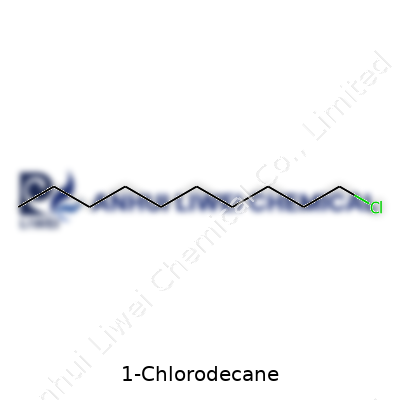
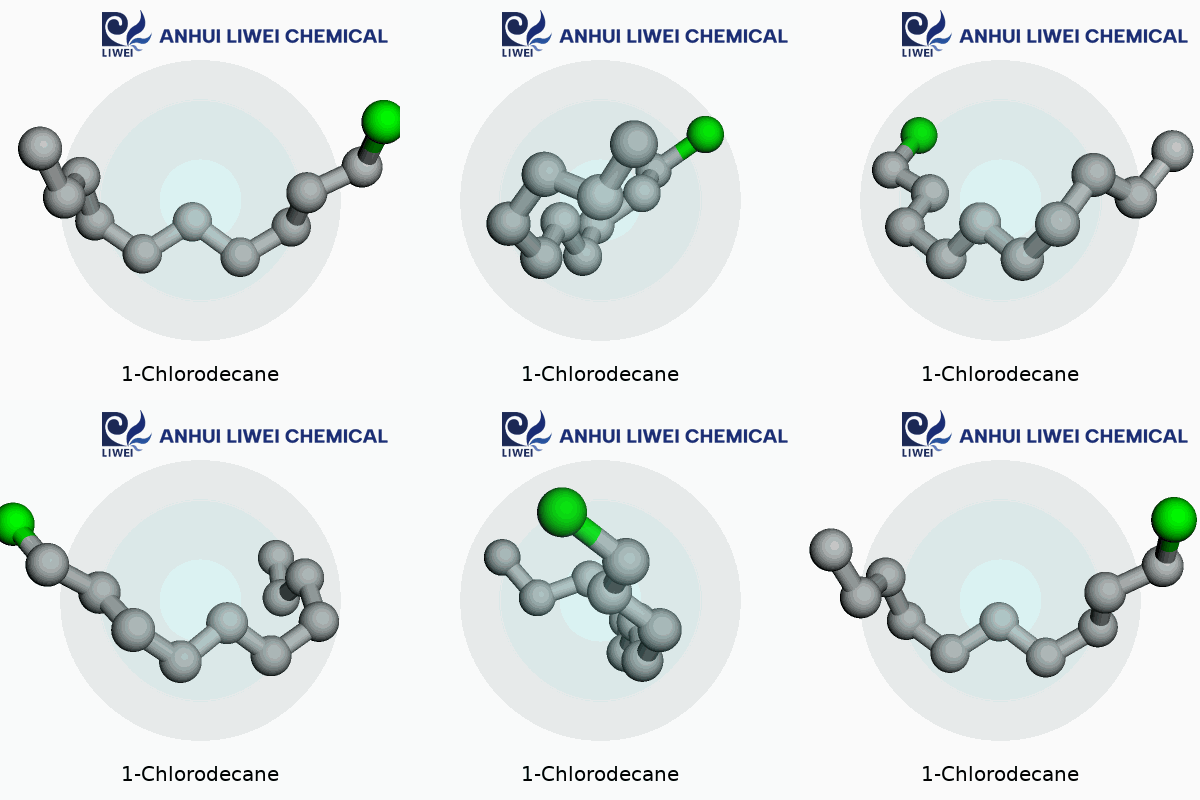
| Names | |
| Preferred IUPAC name | 1-chlorodecane |
| Other names |
Decyl chloride
n-Decyl chloride 1-Decyl chloride Chlorodecane 1-Chloro-decane Decane, 1-chloro- NSC 4046 |
| Pronunciation | /wən.klɔːrə.ˈdɛkeɪn/ |
| Identifiers | |
| CAS Number | 1002-69-3 |
| 3D model (JSmol) | CCCCCCCCCCCl |
| Beilstein Reference | 1-01-00-00375 |
| ChEBI | CHEBI:39150 |
| ChEMBL | CHEMBL16087 |
| ChemSpider | 11120 |
| DrugBank | DB04233 |
| ECHA InfoCard | 100.012.515 |
| EC Number | 213-691-0 |
| Gmelin Reference | 1736103 |
| KEGG | C19343 |
| MeSH | 1-Chlorodecane |
| PubChem CID | 8333 |
| RTECS number | HD6150000 |
| UNII | 6Q5A7L7M6U |
| UN number | 3082 |
| Properties | |
| Chemical formula | C10H21Cl |
| Molar mass | 176.73 g/mol |
| Appearance | Colorless liquid |
| Odor | Mild |
| Density | 0.868 g/mL |
| Solubility in water | 0.0092 mg/L at 25 °C |
| log P | 5.5 |
| Vapor pressure | 0.26 mmHg (25 °C) |
| Acidity (pKa) | 50.0 |
| Magnetic susceptibility (χ) | -0.000000752 cm3/g |
| Refractive index (nD) | 1.437 |
| Viscosity | 1.63 mPa·s (25 °C) |
| Dipole moment | 2.05 D |
| Thermochemistry | |
| Std molar entropy (S⦵298) | 454.9 J/(mol·K) |
| Std enthalpy of formation (ΔfH⦵298) | -367.6 kJ/mol |
| Std enthalpy of combustion (ΔcH⦵298) | -6625.5 kJ/mol |
| Hazards | |
| Main hazards | Causes skin irritation; causes serious eye irritation; may cause respiratory irritation; very toxic to aquatic life with long lasting effects. |
| GHS labelling | Signal word: Warning; Pictograms: GHS07, GHS09; Hazard statements: H315, H319, H335, H410; Precautionary statements: P261, P273, P305+P351+P338, P501 |
| Pictograms | GHS07, GHS09 |
| Signal word | Warning |
| Hazard statements | H315 Causes skin irritation; H319 Causes serious eye irritation; H335 May cause respiratory irritation. |
| Precautionary statements | P261, P264, P271, P273, P280, P302+P352, P304+P340, P305+P351+P338, P312, P321, P332+P313, P337+P313, P362, P391, P403+P233, P405, P501 |
| NFPA 704 (fire diamond) | 2-1-0 |
| Flash point | 95 °C |
| Autoignition temperature | 230 °C |
| Lethal dose or concentration | LD50 (oral, rat): >5000 mg/kg; LD50 (dermal, rabbit): >2000 mg/kg; LC50 (inhalation, rat, 4h): >5.16 mg/L |
| LD50 (median dose) | >5000 mg/kg (oral, rat) |
| NIOSH | HD8600000 |
| PEL (Permissible) | Not established |
| IDLH (Immediate danger) | Not established |
| Related compounds | |
| Related compounds |
1-Chlorononane
1-Chloroundecane 1-Bromodecane 1-Iododecane |


